
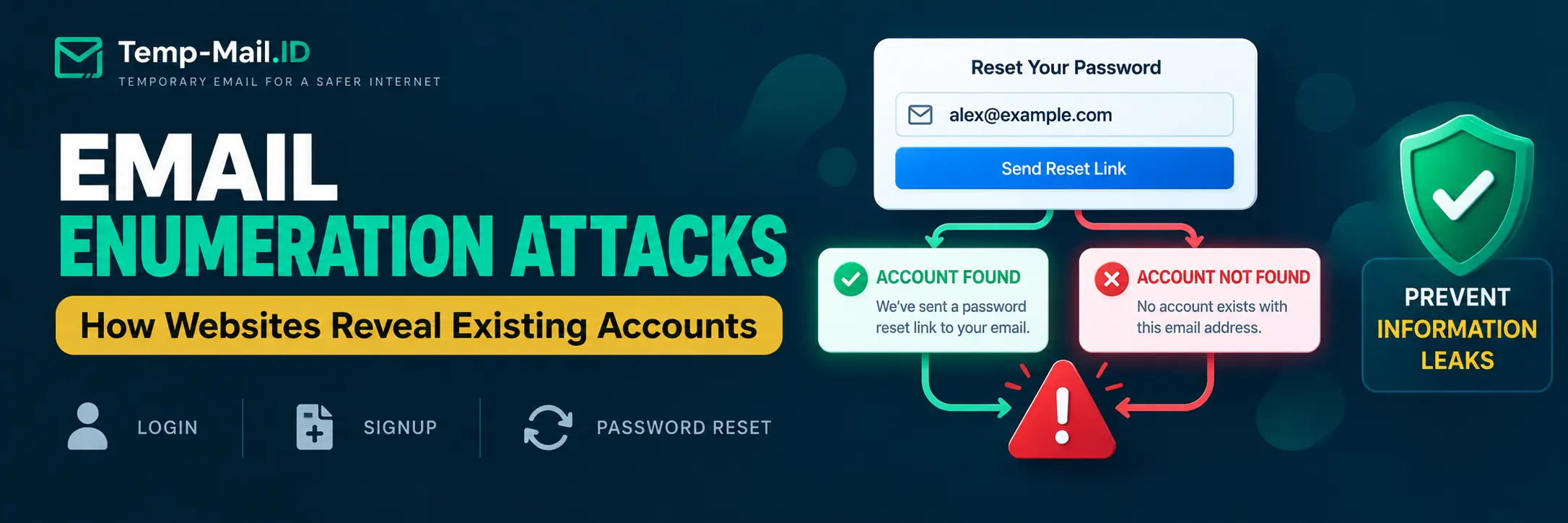
Imagine visiting a website, entering an email address into its password reset form, and immediately learning whether that address belongs to an existing account.
You have not logged in. You have not received a verification code. You do not know the account password. Yet the website has already revealed something about one of its users.
This is the basic problem behind email enumeration attacks.
Account enumeration happens when an application exposes enough information for someone to determine whether a particular username or email address is registered. The information may come from an obvious error message, but it can also appear through differences in response behavior.
For developers, this is an application security problem. For ordinary users, it is a reminder that websites can expose information about account membership without experiencing a traditional database breach.
This guide explains how email enumeration works, why it matters, which application features commonly create the problem, and how teams can test and reduce the risk.
What Are Email Enumeration Attacks?
Email enumeration attacks are attempts to determine whether particular email addresses are associated with accounts on a website or application.
Many services use an email address as the primary account identifier. That makes email convenient for registration, login, password recovery, and account notifications.
However, these same features can accidentally disclose whether an address already exists in the application's user database.
Consider two responses from a fictional website:
Response A: "No account exists with this email address."
Response B: "We have sent password reset instructions."
If the application displays different messages depending on account existence, an unauthenticated visitor may be able to distinguish registered addresses from unregistered ones.
The visitor does not necessarily gain access to an account. Instead, the website reveals information about its account records.
The distinction matters because account discovery and account compromise are different security events.
Why Email Enumeration Matters for Privacy
An email address is often associated with a person's online identity.
Knowing that an address exists is not particularly revealing by itself. Knowing that the same address belongs to a particular service can provide additional context.
For example, account membership may reveal that someone uses a specific professional platform, online community, software product, or other service.
Depending on the type of website, that information may be sensitive.
Enumeration can also support other attacks by helping an attacker identify which accounts exist before attempting phishing, password guessing, or other unauthorized activity.
That does not mean every enumerated account will be compromised. A registered email address is not equivalent to a stolen password.
However, unnecessary disclosure gives an attacker information the application did not need to reveal.
The Open Worldwide Application Security Project, commonly known as OWASP, documents account enumeration as a recognized web application security testing concern.
Its Authentication Cheat Sheet recommends generic authentication responses to reduce differences that reveal account existence.
Where Websites Accidentally Reveal Existing Accounts
Account enumeration is not limited to login forms.
Several common application features can expose the same information through different interfaces.
1. Login Error Messages
A login form may distinguish between an unknown email address and a valid account with an incorrect password.
For example, one response might say that the account does not exist, while another says the password is incorrect.
Although these messages can feel helpful, they may also reveal which account identifiers are valid.
A safer authentication design generally uses a consistent failure message that does not disclose which part of the credentials was incorrect.
2. Password Reset Forms
Password recovery is another common source of account enumeration.
A website may respond differently depending on whether the submitted email address belongs to a registered user.
For example:
Existing account: "Password reset email sent."
Unknown account: "We could not find that email address."
The second response reveals information that an unauthenticated visitor may not need.
OWASP recommends using a consistent response for existing and non-existing accounts during password recovery.
One possible message is:
"If an account matches this address, we will send password reset instructions."
The application can still send a recovery email when appropriate without revealing account existence through the public interface.
3. Registration Forms
Registration creates a more complicated balance between usability and privacy.
Many websites immediately display a message such as "This email address is already registered."
That may help a legitimate user who forgot they previously created an account.
However, it can also disclose that an account exists.
OWASP recommends considering enumeration risks in registration flows as well as login and recovery.
There is no single interface design that fits every application. Teams need to balance user experience, privacy requirements, account recovery, and the sensitivity of account membership.
For privacy-sensitive applications, a generic response combined with an appropriate email-based next step may be preferable.
4. Authentication APIs
Even when the visible interface displays a generic message, the underlying API may reveal more information.
For example, the frontend could show the same message for two failed requests while the backend returns different response codes or JSON structures.
That difference may still be observable.
Security reviews should therefore examine the actual application responses, not only the text displayed in the browser.
5. Response Timing
Account enumeration can also happen when requests follow noticeably different processing paths.
An application might perform additional work for an existing account but return immediately when no account matches the submitted email address.
Repeated differences in response time may reveal information even when the visible messages are identical.
Timing measurements can be affected by network conditions, server load, caching, and other factors. A single slow or fast response does not prove that enumeration is possible.
Nevertheless, consistent processing behavior is an important part of secure authentication design.
Account Enumeration Exposure Matrix
The following matrix summarizes common application behaviors that can expose account existence.
| Application Feature | Potential Information Leak | Safer Design |
|---|---|---|
| Login form | Different errors for unknown email and incorrect password | Use a generic authentication failure response. |
| Password reset | Confirms whether the submitted address exists | Use consistent public responses for both account states. |
| Registration | Immediately identifies an already registered address | Evaluate generic responses and email-based next steps according to privacy requirements. |
| Authentication API | Different status codes, response bodies, or redirects | Review externally observable behavior, not only frontend text. |
| Response timing | Different processing paths reveal account state | Reduce account-dependent timing differences. |
| Account recovery workflow | Different visible outcomes for existing and unknown accounts | Keep unauthenticated responses consistent and use appropriate private recovery channels. |
This matrix is a starting point for security reviews rather than a complete security assessment.
The underlying principle is that an application should avoid exposing unnecessary internal account state to unauthorized visitors.
Email Enumeration vs Password Attacks
These concepts are related but should not be confused.
Email enumeration attempts to determine whether an account exists.
Password guessing attempts to discover authentication credentials.
Credential stuffing involves trying previously obtained username and password combinations against other services.
Phishing attempts to deceive someone into revealing information or performing an unsafe action.
Enumeration may provide useful context for these activities, but it does not automatically accomplish them.
For example, learning that an email address belongs to an account does not prove that the password is weak, that the account has been breached, or that an attacker can access it.
If you receive an unexpected message referencing one of your accounts, our phishing email verification guide explains how to inspect suspicious requests before interacting with them.
How Developers Can Prevent Email Enumeration
Reducing enumeration risk requires more than changing one error message.
Applications should consider every observable difference that may disclose account existence.
1. Use Generic Authentication Responses
When authentication fails, avoid revealing whether the username, email address, or password caused the failure.
A message such as "We could not sign you in with those details" is generally less revealing than separate messages for unknown accounts and incorrect passwords.
The response should remain useful to legitimate users without unnecessarily exposing account state.
2. Keep Password Reset Responses Consistent
Password reset forms should not publicly confirm whether an account exists.
Use a generic acknowledgment for the request and deliver recovery instructions through the appropriate private channel when a matching account exists.
The OWASP Forgot Password Cheat Sheet recommends consistent messages and response timing for existing and non-existing accounts.
3. Review HTTP Responses and API Behavior
Changing the visible text is not enough if the API still exposes different outcomes.
Review status codes, response structures, redirects, and other observable differences.
The goal is to avoid creating an account-existence signal through another part of the application.
4. Reduce Timing Differences
Review whether requests for existing accounts and unknown accounts follow substantially different processing paths.
OWASP recommends consistent response timing and avoiding early-exit behavior that makes account state distinguishable.
This does not require every request to complete in exactly the same number of milliseconds. Real systems experience normal timing variation.
The objective is to avoid predictable differences that reveal internal account state.
5. Limit Automated Requests
Rate limiting and other abuse controls can reduce the ability to submit large numbers of automated requests.
Depending on the application, controls may include request throttling, monitoring, account-specific limits, and additional verification when unusual behavior is detected.
These measures should be designed carefully so attackers cannot easily abuse them to lock legitimate users out of their accounts.
6. Review Registration Privacy
Registration flows deserve their own security review.
A direct duplicate-email warning can be useful for legitimate users, but it also reveals account membership.
Applications handling sensitive account relationships may need a more privacy-conscious workflow.
For example, the interface can acknowledge a registration request without publicly confirming whether the submitted address already belongs to an account.
Any follow-up instructions should be delivered through an appropriate channel controlled by the legitimate address owner.
7. Test the Complete Authentication Lifecycle
Security testing should cover registration, login, password reset, account recovery, and relevant API endpoints.
A change that protects the login form may not protect the recovery flow.
Likewise, a frontend update may leave the underlying API behavior unchanged.
Reviewing these features together helps teams avoid solving enumeration in one location while leaving the same issue elsewhere.
How to Test for Account Enumeration Safely
Developers and QA engineers can evaluate enumeration risks using accounts they control in an authorized staging or test environment.
The objective is to compare how the application behaves when an account exists and when it does not.
Use controlled test identities rather than testing real people's accounts or attempting to discover users on third-party services.
A basic defensive test can follow this process:
- Create a test account using an email address you control.
- Prepare another controlled address that is not registered.
- Review the login failure behavior for both account states.
- Compare password reset acknowledgments.
- Review registration responses for duplicate-account disclosure.
- Inspect externally visible API responses.
- Check for consistent processing behavior.
- Document differences that could reveal account existence.
Tests should use a small, controlled set of accounts and should not trigger unnecessary recovery messages or interfere with other users.
For additional guidance, OWASP publishes an account enumeration testing guide as part of its Web Security Testing Guide.
10-Point Account Enumeration Testing Checklist
Use this checklist during application security reviews or QA acceptance testing.
| Check | What to Review | Expected Security Property |
|---|---|---|
| 1. Login messages | Failed login with existing and unknown accounts | No unnecessary account-existence disclosure |
| 2. Password reset | Recovery request acknowledgments | Consistent public response |
| 3. Registration | Duplicate email behavior | Privacy requirements are considered |
| 4. HTTP status codes | Externally visible response status | No unintended account-state signal |
| 5. API responses | Response body and structure | No unnecessary account-state differences |
| 6. Redirects | Navigation after authentication failures | No revealing account-dependent behavior |
| 7. Timing | Processing behavior across account states | No predictable account-dependent timing signal |
| 8. Rate limiting | Repeated authentication and recovery requests | Automated abuse is constrained |
| 9. Recovery delivery | Private delivery of recovery instructions | Recovery information reaches the appropriate account owner |
| 10. Regression testing | Behavior after authentication changes | Previously addressed leaks do not return |
This checklist is designed for authorized defensive testing. It does not replace a comprehensive application security assessment.
For teams testing registration and transactional email behavior, our temporary email for QA testing guide
What Does CWE-204 Have to Do With Email Enumeration?
MITRE maintains the Common Weakness Enumeration, a classification system for software and hardware weaknesses.
One relevant entry is CWE-204: Observable Response Discrepancy.
This weakness describes situations where a system provides different observable responses that reveal information about its internal state.
Account enumeration can be an example of this broader problem.
For instance, an application may return different authentication errors depending on whether the supplied username exists.
The important issue is not the wording of the message alone. It is the information an unauthorized observer can infer from the application's behavior.
That makes account enumeration a useful topic for developers working on authentication, privacy engineering, secure application design, and QA.
Can Temporary Email Prevent Account Enumeration?
Temporary email and account enumeration address different privacy problems.
A temporary email address can reduce how often your permanent email is shared with websites.
Account enumeration concerns whether a website reveals that an address is registered.
Using a temporary address does not fix an application's enumeration vulnerability.
However, using separate addresses for different low-risk interactions can reduce the reuse of your permanent identifier across unrelated services.
For example, a temporary address used for a disposable test account does not need to reveal the permanent address associated with your important accounts.
That is an exposure-reduction benefit, not a guarantee of anonymity.
For broader guidance on separating email identities, read why using the same email address everywhere can increase exposure.
When Temporary Email Makes Sense for Testing
Temporary email can be useful when developers need controlled inboxes for short-term, low-risk testing.
Examples include checking whether signup messages arrive, whether confirmation links work, and whether transactional email templates display correctly.
A temporary email address can provide a separate receiving destination without involving a personal mailbox.
However, testing account enumeration requires more than receiving email. Developers must also review how the application responds when account identifiers exist or do not exist.
Temporary email should not be used as the recovery address for important production accounts, financial services, healthcare, government services, sensitive business systems, or accounts requiring reliable long-term access.
For those purposes, use a permanent email address or an appropriate long-term alias.
What Should Users Do About Account Enumeration?
Most users cannot directly fix an enumeration vulnerability on a website they do not operate.
However, they can reduce the consequences of account discovery.
Use unique passwords for important accounts and enable multi-factor authentication where available.
Be cautious of unexpected emails that reference services you use. Knowing that you have an account does not make a sender legitimate.
Avoid unnecessarily sharing your primary email address with every website.
If you discover that your address appeared in a breach, follow an appropriate response based on what information was exposed. Our email breach response checklist
If you identify an account enumeration issue in a service, report it responsibly through the organization's official security or support channel.
Frequently Asked Questions
What is an email enumeration attack?
An email enumeration attack attempts to determine whether an email address belongs to an existing account on a website or application. This information may be exposed through login errors, registration messages, password reset responses, API behavior, or timing differences. Enumeration reveals account existence but does not automatically provide access to the account.
Is email enumeration the same as hacking an account?
No. Discovering that an account exists is different from obtaining its password or accessing its private information. Enumeration may help an attacker identify potential targets, but it does not necessarily bypass authentication. Applications should still reduce unnecessary disclosure because account membership can be sensitive and may support other attacks.
How do password reset forms leak account information?
A password reset form can reveal account existence when it displays different responses for registered and unregistered addresses. For example, confirming that an account was found provides information to anyone using the form. OWASP recommends consistent public responses and appropriate controls to reduce account enumeration through password recovery.
Can generic error messages prevent account enumeration?
Generic messages are an important protection, but they are not always sufficient. An application may still reveal account existence through HTTP status codes, API responses, redirects, or processing time. Developers should review the complete externally observable behavior of authentication and recovery flows rather than changing only the text displayed to users.
Is account enumeration always a security vulnerability?
Not necessarily. Some applications intentionally make usernames or account membership public. The security impact depends on the application's design, privacy requirements, and sensitivity of the information disclosed. For services where account existence should remain private, unauthorized disclosure can represent a meaningful security or privacy weakness.
Can temporary email protect my account from enumeration?
Temporary email does not prevent a website from revealing whether an account exists. It can reduce exposure of your permanent email address during short-term, low-risk interactions. For important accounts, unique passwords, multi-factor authentication, and secure account recovery remain more relevant protections than using a disposable inbox.
Final Thoughts
Email enumeration is a useful reminder that privacy problems do not always begin with a stolen database or compromised password.
Sometimes a website reveals information through ordinary features such as login, registration, or password recovery.
For developers, the priority is to review authentication responses, minimize unnecessary account-state disclosure, and test the complete user lifecycle.
For users, the priority is to protect important accounts, recognize suspicious messages, and avoid sharing one permanent email address with every service.
For short-term, low-risk testing and disposable online interactions, Temp-Mail.ID provides a practical way to receive email without using your permanent inbox.
Better account security starts with better application design, while better email privacy starts with being selective about where your address is shared.